Everything Queensland building owners, occupiers and facility managers need to know about AS 1851-2012 servicing, the Building Fire Safety Regulation 2008 (Qld), testing frequencies, logbooks, occupier statements and QBCC enforcement, explained in plain English.
If you occupy or manage a commercial building in Queensland, the law requires your fire protection systems to be inspected, tested and maintained on a strict schedule, and it requires you to prove it. Two documents do most of the heavy lifting: AS 1851-2012, the Australian Standard that sets out what gets tested and how often, and the Building Fire Safety Regulation 2008 (Qld), the state law that makes that maintenance mandatory and puts the obligation on you as the occupier.
Safe QLD Fire Protection takes the stress out of fire safety regulations. We provide reliable inspections, testing, maintenance and compliance reporting that keeps your property protected and compliant to AS 1851, and we back it with clear digital reports that keep your building audit-ready year round. This page explains the framework so you know exactly what is required, and exactly what we handle for you.
AS 1851-2012, Routine Service of Fire Protection Systems and Equipment, is the national benchmark for keeping fire systems in working order after they are installed. It does not tell you how to design or install a system, that is the job of standards like AS 1670.1 for detection and alarms, AS 2118 for sprinklers, AS 2419 for hydrants and AS 2444 for extinguisher selection and location. AS 1851 picks up from the day of handover and governs the entire service life of the asset.
For every system type, the standard prescribes three things:
Whether it be monthly, six-monthly, annual or five-yearly, our team of QBCC licensed technicians is ready to meet your AS 1851 requirements, from the Gold Coast to the Sunshine Coast within a 2 hour service response time.
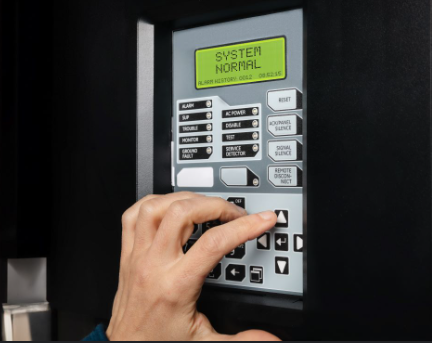
AS 1851 is the how. The Building Fire Safety Regulation 2008 (Qld) is the must. It applies to virtually every commercial, industrial, healthcare, education, accommodation and strata building in Queensland, and it places its duties squarely on the occupier, the person or entity in control of the building.
Every prescribed fire safety installation in the building, alarms, extinguishers, hydrants, hose reels, sprinklers, emergency lighting, fire doors and more, must be maintained so it performs to its design standard, serviced in line with QDC MP6.1 and AS 1851.
Records of all inspection, testing and maintenance must be kept at or near the building, retained for at least two years, and produced for inspection when QFES asks.
Each year the occupier must sign a statement confirming the prescribed fire safety installations have been maintained to the required standard. Safe QLD includes annual occupier statement provisions in our maintenance programs.
Evacuation routes, fire doors and exits must be kept clear and operable at all times. A chocked-open fire door or a pallet in a fire stair is a breach, not a housekeeping issue.
Buildings need a compliant fire and evacuation plan, evacuation diagrams on display, staff instruction, and evacuation practice carried out at the required intervals.
High occupancy buildings, generally workplaces where 30 or more workers are employed, must appoint a trained Fire Safety Adviser. We can point you to what your building needs.
The table below summarises the routine service intervals that apply to the most common fire protection systems in Queensland buildings. It is a guide to the rhythm of a compliant maintenance program, the standard itself contains the full item-by-item schedules our technicians work to on site.
| System | Routine Frequencies | Key Activities & Standard |
|---|---|---|
| Fire extinguishers & fire blankets | Six-monthly · 5-yearly | Six-monthly inspections of condition, charge, access and signage (AS 1851-2012 Section 10). Pressure test and refill every five years or after any use. Selection and location to AS 2444. |
| Fire detection & alarm systems | Monthly · Six-monthly · Annual · 5-yearly | Monthly functional checks of warning devices and indicators, six-monthly inspections, annual full-system test including fault simulations, evacuation tones and battery capacity checks (AS 1851-2012 Section 6). Design and installation to AS 1670.1. |
| Emergency & exit lighting | Six-monthly · Annual | Six-monthly 90-minute discharge tests and annual full-system inspection to AS/NZS 2293.2. Fittings must sustain illumination for at least 90 minutes on power failure. |
| Fire hose reels | Six-monthly · Annual · 5-yearly | Six-monthly checks of access, hose condition and operation, annual flow and pressure checks, five-yearly hydrostatic service (AS 1851-2012). |
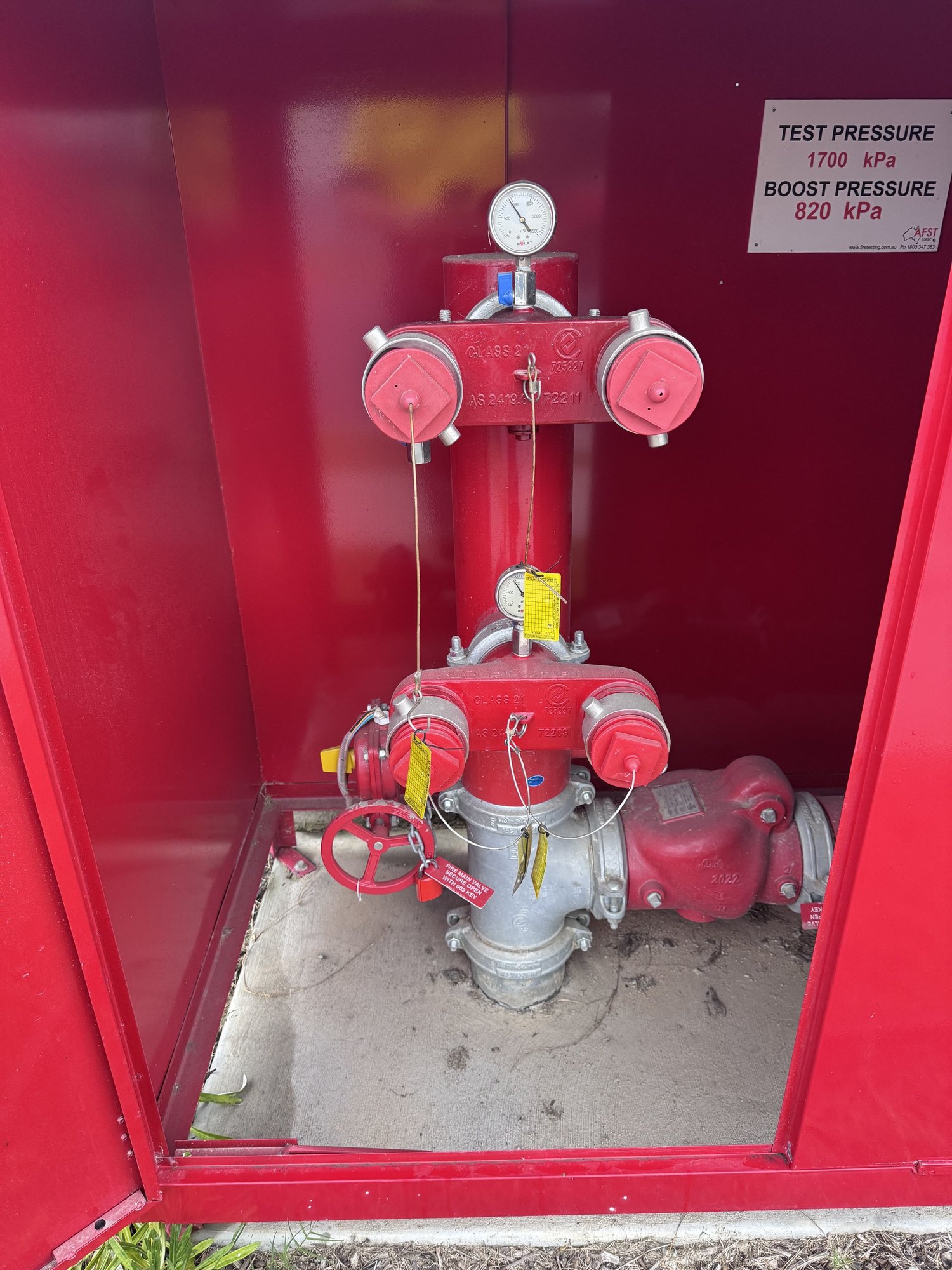
| Fire hydrant systems | Monthly · Six-monthly · Annual · 5-yearly | Monthly visual inspections, six-monthly functional tests, annual flow testing to confirm water supply, five-yearly overhaul including landing valves, check valves and gauges (AS 1851-2012). System design to AS 2419. |
| Fire pumpsets & water tanks | Monthly · Six-monthly · Annual | Regular pump runs, starting battery and driver checks, valve and tank condition inspections through to annual full performance testing (AS 1851-2012). Pumped and un-pumped systems both covered. |
| Automatic sprinkler systems | Monthly · Six-monthly · Annual · 5-yearly | Monthly inspections, annual full-system testing of water flow and alarm function, five-yearly comprehensive assessment including pipework and sprinkler head condition (AS 1851-2012). Design to AS 2118. |
| Special hazard & gaseous suppression | Monthly · Six-monthly · Annual | Agent quantity and pressure checks, actuation and interface testing, room integrity considerations for gaseous systems (AS 1851-2012). |
| Fire doors & passive fire | Six-monthly to Annual | Inspection of door leaf, frame, seals, closers and tags to AS 1905.1, six-monthly on the majority of door sets depending on the situation. Annual inspection of penetrations, dampers and fire-rated construction (AS 1851-2012). |
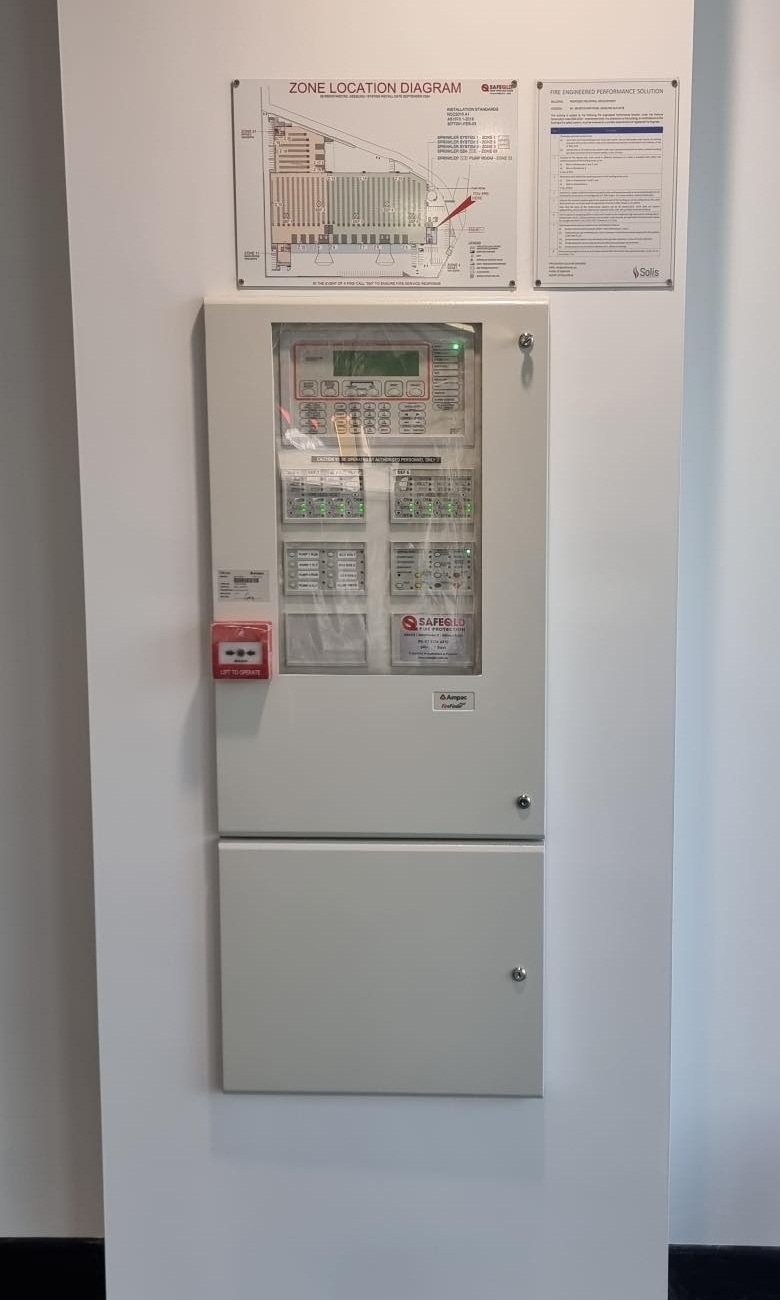
Under AS 1851, every routine inspection and test must be recorded in a logbook or digital maintenance record: the date, the items serviced, the results, any defects found and the corrective action taken. Under the Building Fire Safety Regulation 2008 (Qld), those records must be kept at or near the building, retained for at least two years, and be available for inspection.
Failure to keep compliant records can lead to enforcement notices from the QBCC or Fire Safety Officers. It is the most common compliance gap we find in buildings we take over, and the easiest one to fix.
Fire protection work in Queensland is licensed work. Every technician who inspects, tests or maintains a fire protection system must hold the appropriate QBCC fire protection licence, and licensees carry statutory reporting duties that keep defects from being quietly ignored.
The QBCC licenses fire protection contractors and technicians by class of work. Safe QLD holds QBCC Licence No. 1143420 and fields a team of QBCC licensed technicians across every discipline we service.
When a licensee finds a fire protection system that does not conform to the required standard, they must give the owner or occupier a written notice of non-conformance, QBCC Form 71, identifying the defect.
If the non-conformance is not rectified within the required timeframe, the licensee must notify the QBCC using Form 72. Unresolved defects reach the regulator, so acting on Form 71 promptly matters.
QFES officers can inspect buildings, require records, and issue requisitions and enforcement action under the Fire Services Act and the Building Fire Safety Regulation 2008 (Qld) where occupiers fall short.
Anyone can offer a low price. Very few deliver low risk. Our maintenance programs are built to give you the best long-term value: accurate testing, clear reporting, and defects identified early, not after they have become expensive problems.
Every Safe QLD service visit ends with detailed digital compliance reporting: what was tested, what passed, what needs attention and why, mapped against your AS 1851 schedule. Your records stay complete, current and audit-ready, so an occupier's statement, QFES inspection or insurance review is a formality instead of a scramble.
We survey your building, identify every prescribed fire safety installation, and benchmark its condition and records against AS 1851 and the Building Fire Safety Regulation 2008 (Qld).
Critical defects are actioned fast, non-critical defects are quoted and scheduled, and any outstanding Form 71 items are closed out properly.
Your monthly, six-monthly, annual and five-yearly routines run automatically, delivered by QBCC licensed technicians across South East Queensland.
Digital reports, maintained logbooks and annual occupier statement provisions keep you ready for QFES, QBCC, auditors and insurers at any moment.
More questions about a specific system? Visit our full fire safety FAQs or call us on (07) 3286 6310.
Monthly, six-monthly, annual and five-yearly AS 1851 Section 6 servicing of panels, detectors, EWIS and occupant warning systems.
Explore alarm servicingSix-monthly inspections and five-yearly pressure testing to AS 1851-2012 Section 10, with reliable equipment at affordable prices.
Explore portable equipmentSix-monthly discharge testing and annual inspections to AS/NZS 2293.2, delivered by our specialist electrical contractors.
Explore E&E lightingFast response across South East Queensland. Clear digital reports. Audit-ready compliance.